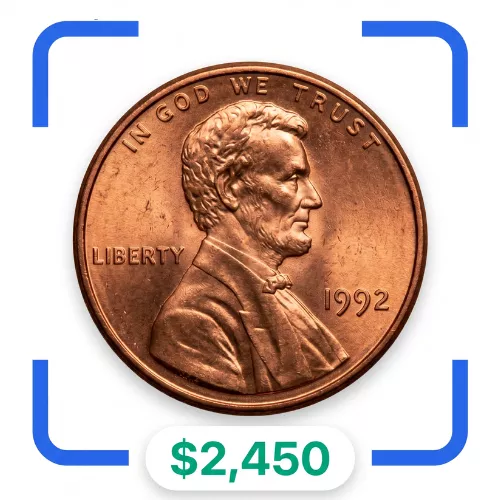
Free 2001 Half Dollar Value Calculator
Select your mint mark, condition, and any errors to estimate your coin's current market value.
If you're not yet sure about your coin's mint mark or condition, the 2001 Half Dollar Coin Value Checker tool is a free third-party resource that lets you upload photos and get an AI-powered estimate without any numismatic knowledge required.
Do You Have a Rare 2001-P MS68 Specimen?
The 2001-P Kennedy half dollar in MS68 is the signature high-value coin of this series — only around 190 examples have ever earned that grade from PCGS. Use this checker to assess whether your coin has what it takes.

❌ Common Circulated Example
- Flat, dull surface — luster fully gone
- Wear visible on Kennedy's cheek and jaw
- Eagle's breast feathers smooth and flat
- Contact marks or bag marks visible to naked eye
- Worth: face value to ~$3
✅ Rare MS68 Gem Example
- Full cartwheel luster, brilliant and unbroken
- Kennedy's cheek virtually free of contact marks
- Sharp, distinct eagle feathers on reverse
- No distracting marks or hairlines under 5× magnification
- Worth: $400–$900+ (PCGS certified)
Check Your Coin Against These 4 Criteria:
Want a number, not just a yes or no?
The checker above tells you if your coin has gem potential. The calculator gives you a real dollar estimate based on mint mark, grade, and errors.
Everything on This Page
Jump directly to the section you need:
The Valuable 2001 Kennedy Half Dollar Errors (Complete Guide)
While most 2001 Kennedy half dollars were struck without incident across roughly 40 million coins, production errors do occur during high-volume minting. Authenticated examples of the varieties below command significant premiums over standard coins. Each variety is ordered by collectible value potential.
 Most Famous
Off-Center Strike Error
$20 – $200+An off-center strike occurs when the coin blank (planchet) is not properly positioned under the dies at the moment of striking. The ejection mechanism or feeding system fails to center the planchet, causing only a portion of the intended design to be transferred to the coin's surface. On a 40+ million coin production run, several hundred off-center strikes may escape quality control.
To identify an off-center strike, look for a crescent-shaped area of blank, unstruck metal on one side of the coin with a complete or partial design on the opposite side. The degree of misalignment is measured as a percentage: a 10% off-center example shows modest premium, while a 50% off-center strike with the full date visible can command the highest prices. The date must remain legible for maximum collector interest.
Collector demand for off-center Kennedy halves remains strong because the large coin format makes the visual impact dramatic. Mildly broadstruck examples with 5–15% misalignment sell in the $20–$50 range, while dramatic 40–60% off-center pieces with visible dates can reach $150–$200 or more at auction. Authentication by PCGS or NGC is recommended for pieces commanding more than $75.
 Most Valuable
Doubled Die Obverse (DDO)
$50 – $500+A doubled die obverse error results from a misalignment between two impressions made into the working die during the hubbing process. When the hub transfers the master design to the working die in multiple passes, any slight rotation or shift between passes creates a doubled image that is permanently engraved into the die itself — meaning every coin struck from that die carries the doubling.
On the 2001 Kennedy half dollar, look for DDO varieties on the obverse inscription "IN GOD WE TRUST" and "LIBERTY" — the serifs and curves of these letters are prime areas to show notching or separation. Kennedy's portrait details, particularly along the hair waves and neck truncation, may also exhibit visible doubling under a 5× to 10× loupe. Class I (rotated hub) doubling is the most collectible type.
The value potential for a confirmed 2001 DDO is significant: authenticated doubled die Kennedy halves from the late 1990s and early 2000s have fetched $100–$500 in Mint State grades. The well-documented 1974-D DDO FS-101, which commands $500–$850 in uncirculated condition, demonstrates the price ceiling this category can reach. Any 2001 DDO requires PCGS or NGC certification to achieve full market premium.
 Rarest Strike Error
Broadstrike Error (Collar Failure)
$20 – $150+A broadstrike error is produced when the retaining collar — the hardened steel ring that surrounds the planchet during striking and ensures the coin emerges at exactly 30.61mm — either malfunctions or is entirely absent at the moment of impact. Without the collar's containment, the metal in the planchet spreads outward under the enormous striking pressure, producing a coin that is simultaneously wider and thinner than intended.
Identification is straightforward with a caliper: a broadstruck 2001 Kennedy half dollar will measure noticeably wider than 30.61mm, while the reeded edge — normally crisp and uniform — will be absent or partially present, fading into a smooth, spread edge. The design elements may appear stretched toward the periphery, with legends and devices pushed outward. The coin will also feel lighter in the hand due to its reduced thickness.
Value depends primarily on the degree of spread: a mildly broadstruck example with only a few millimeters of expansion typically trades for $20–$50. Dramatically broadstruck pieces with full design spread and no reeding can reach $75–$150 or more. Condition matters particularly for this error type because the thinner, expanded planchet is more susceptible to post-mint dings and scratches that reduce the premium substantially.
 Best Kept Secret
Wrong Planchet / Off-Metal Strike
$200 – $1,000+Wrong planchet errors are among the rarest and most spectacular error types that occur at the U.S. Mint. They happen when a blank planchet intended for a different denomination — such as a quarter, dollar, or foreign coin blank — accidentally enters the half dollar press and receives a full strike from the half dollar dies. The extreme mismatch between the design and the planchet's physical characteristics makes these coins immediately recognizable.
A 2001 Kennedy half dollar struck on a wrong planchet will exhibit the design of the half dollar but with abnormal physical characteristics. For example, a half dollar struck on a quarter planchet will be smaller in diameter with the half dollar design sharply cut off at the smaller coin's edge. A half dollar struck on a dollar planchet will be slightly larger with design elements appearing less fully struck. The color may also differ if the wrong planchet was struck in silver or another metal composition.
Wrong planchet errors command the highest premiums of all Kennedy half dollar errors. Authenticated and certified examples can sell for $200 to $1,000 or more, with the final price determined by the denomination of the wrong planchet, overall eye appeal, and the drama of the mismatch. These are genuinely rare coins that appear only a handful of times per decade at major auction houses and require mandatory PCGS or NGC certification to achieve premium prices.
2001 Kennedy Half Dollar Mintage & Survival Data

| Variety | Mint | Mintage | Est. Survival | Survival Rate |
|---|---|---|---|---|
| 2001-P (Circulation Strike) | Philadelphia | 21,200,000 | ~16,960,000 | ~80% |
| 2001-D (Circulation Strike) | Denver | 19,504,000 | ~15,603,200 | ~80% |
| 2001-S Clad Proof DCAM | San Francisco | 2,294,909 | ~2,248,162 | ~98% |
| 2001-S Silver Proof DCAM | San Francisco | 889,697 | ~871,903 | ~98% |
| Total All Issues | — | 43,888,606 | — | — |
Found one of these errors on your coin?
Use the calculator above to get an estimated value based on your specific mint mark, condition, and error type — it takes less than 30 seconds.
Get My Coin's Value →Describe Your 2001 Half Dollar for a Detailed Assessment
Not sure how to use the calculator? Describe your coin in plain language and our analyzer will interpret your description to give you a tailored value assessment.
Mention these things if you can
- Mint mark (P, D, or S)
- Any visible wear or shine
- Off-center or misaligned design
- Doubled lettering visible
- Unusual edge (smooth instead of reeded)
- Any obvious errors or anomalies
Also helpful
- Whether it's been cleaned
- From a proof set (mirror-like fields)
- Color or toning description
- Any surface marks or scratches
- Whether it's in a PCGS/NGC holder
- Where you found it (bank roll, jar, etc.)
2001 Half Dollar Value Chart at a Glance
The chart below covers all four 2001 Kennedy half dollar varieties across four condition tiers. For a complete illustrated step-by-step 2001 half dollar identification breakdown with current price data, visit CoinValueApp's dedicated guide. Values shown are approximate market ranges based on PCGS, Greysheet, and recent Heritage auction data.
| Variety | Worn (AG–G) | Circulated (VG–AU) | Uncirculated (MS60–MS66) | Gem / Proof (MS67+/PR70) |
|---|---|---|---|---|
| 2001-P (Philadelphia) | $0.50–$1 | $1–$3 | $4–$25 | $50–$900+ |
| ⭐ 2001-P MS68 (Signature) | — | — | — | $400–$900 (PCGS only) |
| 2001-D (Denver) | $0.50–$1 | $1–$3 | $4–$20 | $25–$195 |
| 2001-S Clad Proof DCAM | — | — | — | $5–$42 (PR65–PR70) |
| 🔴 2001-S Silver Proof DCAM | — | — | — | $34–$55 (PR65–PR70) |
📱 CoinKnow Coin Identifier App gives you a fast on-the-go way to scan your 2001 Kennedy half dollar and cross-check value estimates against real-time market data — a coin identifier and value app.
How to Grade Your 2001 Kennedy Half Dollar
The 2001 Kennedy half dollar uses the Sheldon 1–70 scale. For clad issues from this era, value concentrates almost entirely in high Mint State grades — knowing which tier your coin falls into determines whether it's worth face value or several hundred dollars.

Worn (AG–G4)
Heavy circulation wear is evident across all high points. Kennedy's portrait is flattened on the cheek and jaw; the hair detail above the ear is largely gone. The eagle's breast feathers merge into a smooth field. No luster remains. These coins are worth face value at best — the clad composition has no silver to support a melt premium.
Circulated (VG–AU58)
Light to moderate wear is visible on Kennedy's cheek and the hair above the ear. In About Uncirculated (AU) examples, just a trace of rub appears on the highest points, with most of the original luster still present in protected areas. Circulated 2001 halves typically trade at or just above face value unless they grade AU55 or better.
Uncirculated (MS60–MS66)
No wear exists, but contact marks and bag marks from normal mint handling are visible. MS63–MS64 examples show noticeable marks on Kennedy's cheek. MS65 (Gem) coins have minimal marks and strong luster. MS66 specimens show very clean surfaces with excellent eye appeal. Most examples from bank rolls fall in the MS63–MS65 range.
Gem / Superb Gem (MS67–MS68+)
MS67 coins are virtually mark-free with exceptional strike and luster — only a handful of tiny imperfections exist. MS68 is a trophy grade: PCGS has certified only around 190 examples of the 2001-P at this level, with 2 coins grading higher at MS68+. The top auction record of $900 was set by an MS68 example at Heritage in 2018.
🔬 CoinKnow Coin Identifier App lets you photograph your coin and compare it against database images of graded Kennedy half dollar examples, helping you match your specimen's condition before committing to a grading submission — a coin identifier and value app.
Where to Sell Your Valuable 2001 Half Dollar
Your selling strategy depends entirely on your coin's grade. Low-grade examples are fine for coin shops and online lots; high-grade or error coins belong at auction or on certified coin marketplaces for maximum return.
🏛️ Heritage Auctions
The top destination for any 2001-P or 2001-D grading MS67 or above, or any certified error coin. Heritage reached the $900 record for a 2001-P MS68. Their Kennedy half dollar buyer base is deep and competitive. Submit coins via their direct consignment portal — no seller's fee on coins realizing under $1,000 for new consignors.
🛒 eBay / Online Platforms
For certified MS63–MS66 examples, eBay connects you directly with the largest collector audience. Check recently sold prices for 2001 Kennedy half dollar completed eBay listings to benchmark your coin's market value before setting your asking price. PCGS and NGC holders always command premiums over raw coins at any grade.
🏪 Local Coin Shop
For circulated examples or lower Mint State coins (MS60–MS63), a local coin dealer offers convenience at the cost of a wholesale discount — expect 50–70% of retail value. Best for quick cash without the hassle of shipping and waiting for auction settlement. Bring multiple coins in one visit to reduce per-coin overhead.
💬 Reddit r/Coins
The r/coins and r/CRH (Coin Roll Hunting) communities are excellent for initial identification and community pricing of error finds. Before selling anywhere, post photos to get community opinions on whether your suspected error is genuine. Members can often point you toward the best venue based on the specific error type.
🏅 Always Grade Before Selling High-Value Examples
If your 2001 Kennedy half dollar appears problem-free and gem-bright, professional grading by PCGS or NGC is strongly recommended before selling. The 2001-P MS68 sold for $900 certified — the same coin raw might fetch only $40–$80. Grading costs are typically $30–$50 per coin for standard service, making it financially worthwhile at MS67 and above. PCGS estimates of population and condition census data also give buyers confidence, directly supporting the premium price.
Frequently Asked Questions
How much is a 2001 half dollar worth in circulated condition?
What is the most valuable 2001 half dollar ever sold?
Does the 2001 half dollar contain silver?
Why is the 2001-P half dollar historically significant?
How can I tell the difference between a 2001-P and 2001-D half dollar?
What grades are considered rare for the 2001 Kennedy half dollar?
How much is the 2001-S Silver Proof half dollar worth?
What errors exist on the 2001 half dollar?
Is a 2001 half dollar in an original bank roll worth more?
Should I get my 2001 half dollar professionally graded?
Ready to find out what your 2001 half dollar is worth?
Use our free calculator — just pick your mint mark, condition, and any errors. Instant results, no signup required.
Calculate My Coin's Value →